
How Much Do Custom Cabinets Cost in Austin, TX?
"How much do custom cabinets cost?" is usually the first question, and it deserves an honest answer. The honest answer is that a single number isn't useful. The same room can come in several times different depending on decisions made during design, and a published figure would either undersell a real project or mislead you. We don't publish dollar figures. What we can do — and what's actually useful early — is show which factors move the number, so the conversation is about real trade-offs instead of guesses.
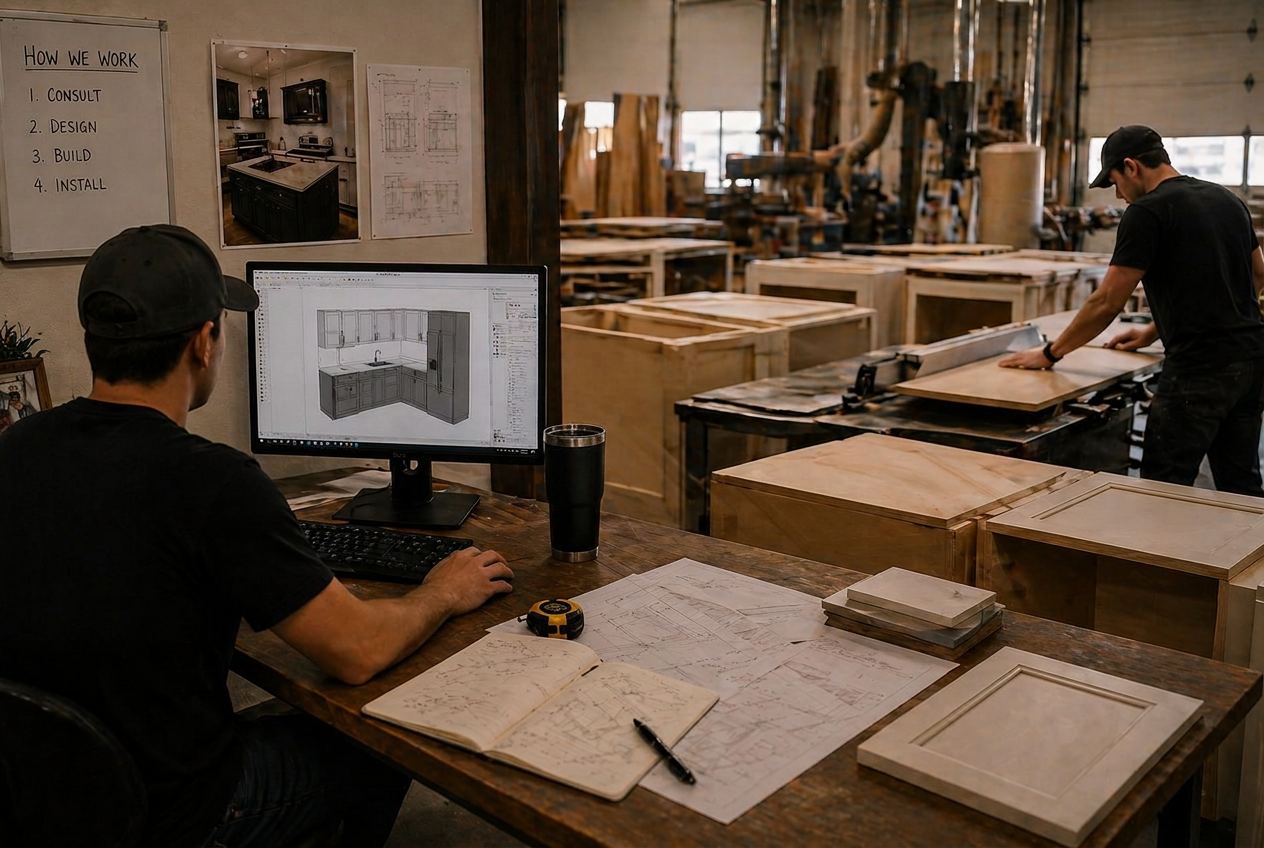
Photo: Verde Cabinet Studio
What actually drives cabinet cost
Cabinetry is priced on a set of specific factors. Understanding these before you start helps you plan and keeps surprises out of the later stages.
- Scope and quantity — how many cabinets, how many rooms, and whether the work is one continuous field or separate small scopes.
- Construction method — face-frame, frameless, and flush inset differ in machining, fitting time, and tolerance. Inset costs the most to hold true.
- Materials and finish — species, veneer matching, decorative panel brand, paint-grade versus stain-grade, and how many finish steps the schedule calls for.
- Size and height — ceiling-height runs, oversized doors, and deep boxes add material, structure, and handling.
- Special shapes and details — curves, angles, integrated appliance panels, mitered edges, and aligned reveals across a long field all add drawing and shop time.
- Hardware and interior function — hinge and runner level, lift systems, pocket doors, and interior organization can move a budget more than the cabinet boxes do.
- Site and access — stairs, tight turns, occupied homes, and out-of-square existing conditions affect installation time.
- Installation and schedule — install duration, trade sequencing, and whether the date is fixed. Compressed schedules cost more than generous ones.
Why a per-cabinet price misleads
A price-per-cabinet number treats every cabinet as equal. It isn't. A tall pantry with internals, a mitered finished end, and soft-close storage is a different animal than a simple wall box. Quoting by the cabinet hides the decisions that actually drive the total. A project quote — built from the real scope, materials, and conditions — is the only number worth relying on, and it can only be honest once the design is developed.
Stock, semi-custom, and custom: what changes
It helps to know where the price differences come from. Stock cabinetry is built to a catalog, in standard sizes, from cost-driven materials, and pulled from inventory. Semi-custom widens the size and finish options but still works within a manufacturer's system. Custom cabinetry is designed around your room, your materials, and your details, and built for that space — which is where both the quality and the cost come from.
None of these is wrong for every project. The question is what your room, your plans, and your daily use actually need.
Value engineering, not quiet substitution
When a scope comes in above where it needs to be, value engineering means protecting the design intent and the way the cabinetry functions while adjusting what carries the cost — material choice on unseen surfaces, front style, hardware level, or the extent of the run. It is a set of documented decisions you see and agree to, not a quiet substitution made to hit a number.
What to ask when comparing quotes
- Is the cabinet box ¾" plywood, or something else?
- Are the drawer boxes dovetail, and in what material?
- Are the slides undermount soft-close, and what brand and level?
- What finish system is used — primer, coats, and curing?
- What hardware is included, and what is an upgrade?
- Is installation included, and how is site access handled?
- What is documented in the approval drawings before production?
Two quotes can land far apart and look similar on the surface. The construction and the process behind them are what you're really comparing.
Send the drawings. We'll review the scope.
The first step is a conversation about the drawings and the conditions. Everything else follows from that.