
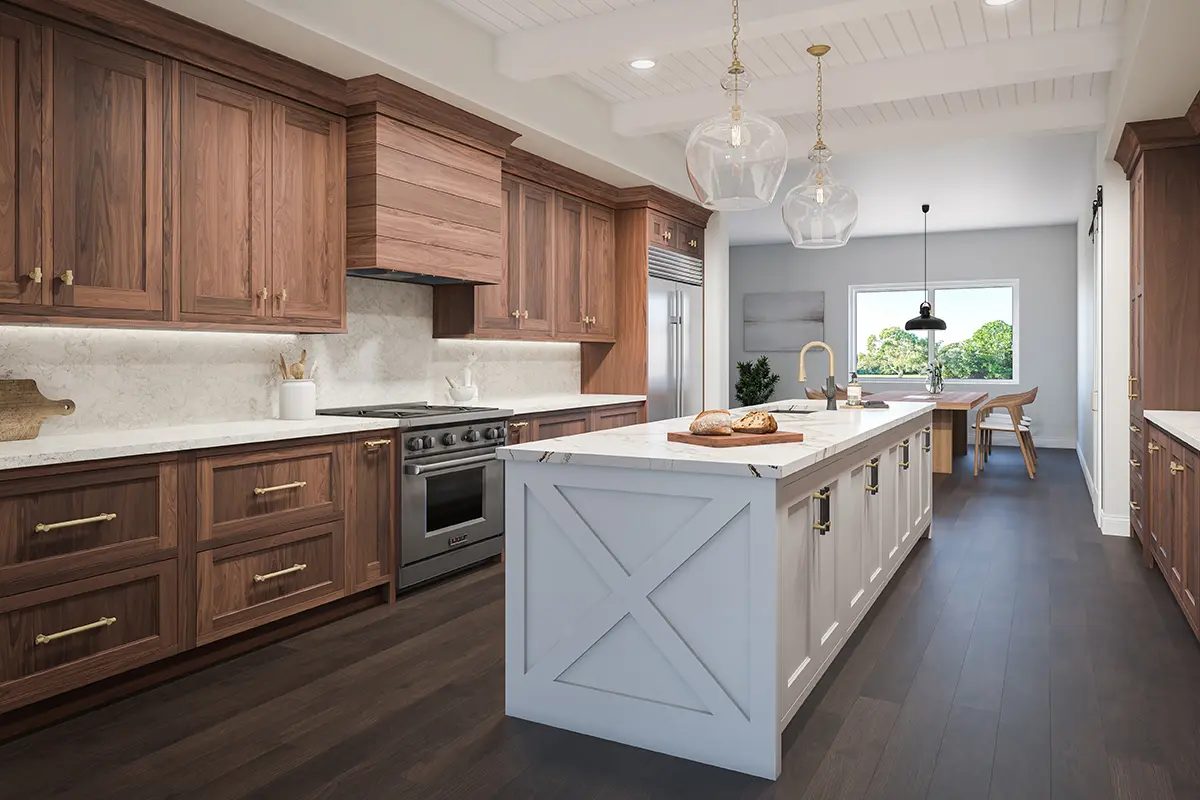
Finished walnut cabinetry showing natural grain, sheen, and aligned inset fronts
Natural grain and finish in a completed roomPhoto: Verde Cabinet Studio
Design Library — Finishes

A finish is a complete system, not just a color.

Paint, stain, clear, and oil each change how cabinetry looks, feels, ages, and can be repaired. We narrow the system by substrate, room conditions, use, sheen, maintenance expectations, and an approved physical sample.

01

Four finish directions

Natural grain remains visible under stain, clear, and oil; paint creates an opaque surface. None is automatically right for every cabinet or every room.

Paint

An opaque finish that puts color, front profile, and sheen ahead of visible grain. Substrate selection matters: stable paint-grade MDF/HDF is useful on broad center panels, while hardwood and other paint-grade components are chosen for edges, frames, moldings, and structure.

Stain

A translucent color system that shifts wood tone while leaving grain visible. Species, cut, board variation, sanding, and end grain all affect the result, so the approved sample must use the actual substrate and preparation sequence.

Clear

A transparent protective system used when the wood's natural color and figure are the design. Every clear changes tone to some degree; sample boards reveal how much warmth, contrast, and sheen the selected system adds.

Oil

A distinct low-build finish direction that emphasizes touch and natural grain. Rubio Monocoat Oil Plus 2C is normally applied by pad or brush, worked into the surface, and wiped free of excess according to its technical data. It is not generic sprayed polyurethane.

02

Essential, Tailored, and Signature

These are selection paths, not product rankings. Investment bands overlap because the room, substrate, preparation, color, sheen, access, and repair expectations determine the actual scope.

lower investment

Essential

Purpose
A focused, durable direction with fewer finish variables.
Typical review
One suitable system and a concise sample set.
Useful for
Painted utility cabinetry, straightforward built-ins, or a clear natural-wood direction.

middle investment

Tailored

Purpose
More control over color, substrate, sheen, and room-to-room coordination.
Typical review
Comparative samples on the proposed substrate, with sheen and adjacent materials reviewed together.
Useful for
Kitchens, vanities, bars, and mixed paint/wood rooms needing careful coordination.

higher investment

Signature

Purpose
A highly resolved finish package where grain, tone, sheen, and architectural details are central to the commission.
Typical review
Larger or sequenced samples, multiple components, and added mockup/detail review where the design warrants it.
Useful for
Feature rooms, inset work, matched veneer or solid wood, specialty profiles, and one-piece commissions.
03

Substrate, sheen, and physical approval

The same product and color can look different over maple, MDF, white oak, walnut, veneer, or a previously sealed surface — and different again in matte, satin, or higher sheen.

Sample the real assembly

Approve the proposed substrate, preparation, color, build, and sheen together. Screen color and a manufacturer's chip can guide the first conversation but cannot approve the result.

Read natural variation

Stain, clear, and oil reveal board-to-board variation, grain direction, veneer sequence, end grain, and how light changes the tone. A sample is representative, not a promise that every board will be identical.

Plan sheen by use

Lower sheen tends to soften surface variation; higher sheen reflects more light and makes preparation and handling more visible. The decision belongs to the whole room, not a name on a fan deck.

Confirm compatibility

Exact primer, color coat, clear coat, substrate, application method, recoat window, and cure requirements are checked against current product data and the approved sample. No product is assumed compatible with every tool or every base coat.

04

The complete fit-and-finish sequence

For the field-finished work this studio takes on, final finishing begins only after the cabinetry has become one fitted architectural assembly.

  1. 01Fabricate
  2. 02Complete shop preparation
  3. 03Deliver
  4. 04Install
  5. 05Fully field-fit
  6. 06Complete joining, scribes, fillers, panels, moldings, and adjustments
  7. 07Protect the room and contain the work area
  8. 08Complete final preparation
  9. 09Apply the approved paint, stain, or clear finish
  10. 10Allow the specified cure
  11. 11Reinstall hardware and reassemble
  12. 12Complete final adjustments
  13. 13Touch up
  14. 14Clean up

Wood moves and buildings move. Careful fitting, joinery, preparation, and finish can make transitions quiet and coherent, but no responsible finish specification promises permanently invisible wood joints.

05

Dry is not cured

A coating may feel dry or accept careful handling before it reaches its fuller service properties. Cure time depends on the exact system, film build, temperature, humidity, airflow, and manufacturer instructions.

Early use

Follow the written handoff for the selected system. Avoid aggressive cleaning, tape, rubber mats, standing water, and heavy contact while the finish is still curing.

Routine care

Use a soft, barely damp cloth and dry the surface. Clean spills promptly and avoid abrasives, scouring pads, bleach, ammonia, and solvent cleaners unless the approved finish manufacturer specifically permits them.

Repair expectations

Paint can often be locally touched up, though sheen and aging may remain visible. Clear, stain, and oil repairs depend on damage depth, wood color, grain, and the original system; a discreet sample repair is the honest first step.

Maintenance

Oil systems can have product-specific maintenance or renewal procedures. Painted and clear-film systems have different repair paths. The final care note should name the approved system rather than rely on generic advice.

06

Product families for sample and specification review

These are commercially available candidates, not claims of certification, dealership, stock, universal compatibility, or a fixed house system.

Waterborne paint candidates: Sherwin-Williams Emerald Urethane Trim Enamel, Benjamin Moore ADVANCE, Sherwin-Williams Gallery Series Waterborne Topcoat, and General Finishes Enduro White Poly / Enduro Black Poly. Application method and equipment compatibility are verified from the current technical data before sampling.

Stain and clear candidates: General Finishes Water Based Wood Stain and General Finishes High Performance Water Based Topcoat; Minwax Wood Finish Water-Based Semi-Transparent Color Stain. A candidate is reviewed as part of a manufacturer-supported system. Products from different brands are not layered by assumption.

Oil candidate: Rubio Monocoat Oil Plus 2C, treated as its own pad- or brush-applied oil system with excess removal and product-specific care — not described as sprayed polyurethane.

Selection rule

Product families are starting points for sample and specification review, not claims of dealership, stock, certification, or universal suitability. The final system is confirmed with current manufacturer and supplier guidance, compatibility review, and an approved sample on the project substrate.

Finish review

Approve the system, substrate, color, and sheen together.

Bring the room palette and material direction. We'll identify the finish questions that need a physical sample before the cabinetry moves forward.