
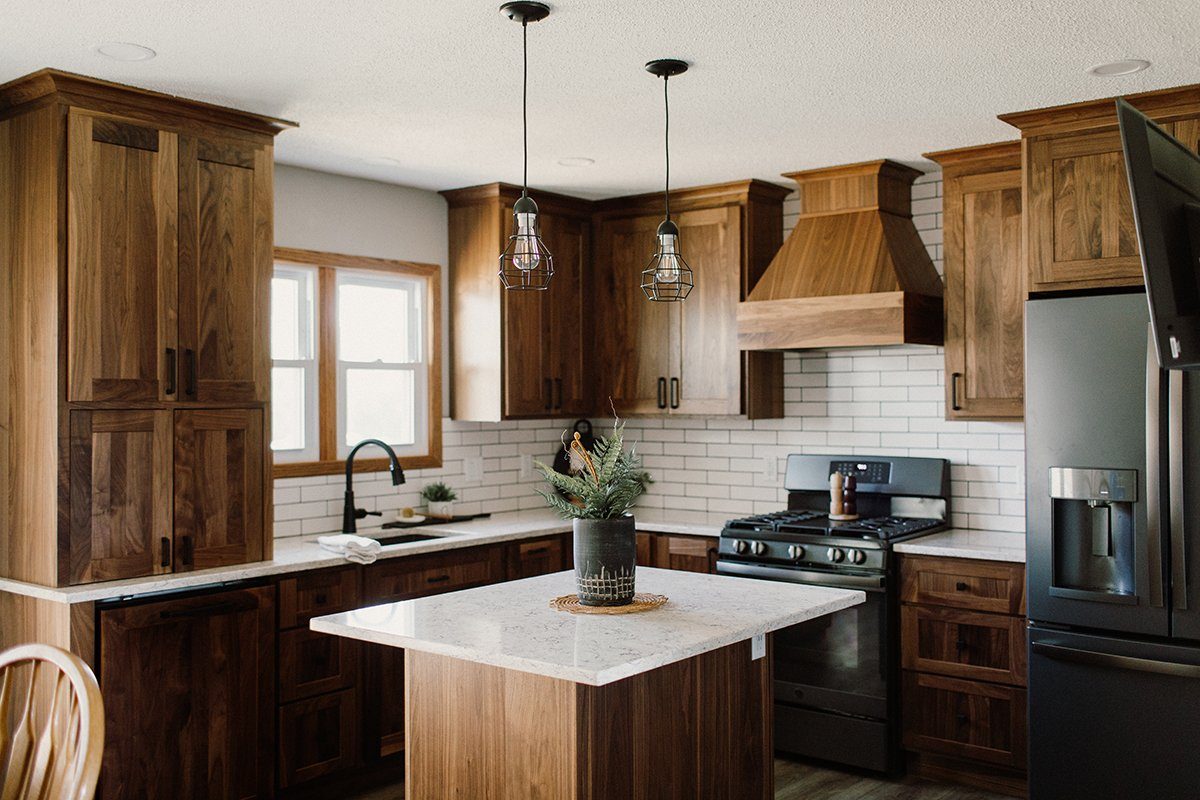
Wood behaves like wood.
A working sample library of the species and paint-grade materials we specify most often, with the variation, matching, and sourcing realities stated up front rather than discovered at delivery.
Screens are not samples
Color, tone, and grain on this page are indicative only. Monitors, ambient light, and finish schedules all shift the result. Final species, cut, and finish selections are made from current physical samples reviewed under the project's own lighting.
White oak
The species most Austin projects ask for, and the one where the cut matters most.
Plain-sawn appearance
The most available cut. Wide cathedral figure with strong variation from board to board — warm and lively rather than uniform.
Rift-cut appearance
Straight, tight, consistent grain lines with the cathedral figure largely absent. Specified when the design wants calm verticals across a run — covered on its own below.
Quarter-sawn appearance
Straight grain with the characteristic ray fleck. Specified and sourced when available; the fleck is part of the material, not a defect.
What we won't promise
We do not promise exact visual uniformity across a cabinetry package. Cut availability, yield, and board character vary by supplier and lot.
Rift-cut white oak
The cut designers specify by name when the run has to read as one calm, vertical material.
What rift-cut actually is
Boards milled at roughly a 30-60 degree angle to the growth rings, producing straight, tight, even grain lines with the cathedral figure and the quarter-sawn ray fleck largely absent.
Why it costs more
Rift yields far less usable material per log than plain-sawn, and it is ordered as a specific cut rather than pulled from general stock. Availability and lead time follow the cut, not the species.
Solid and veneer together
Rift white oak veneer is used for large panels and continuous runs; rift solids carry the door frames, edges, and exposed structure. Matching solids to veneer is a specification decision made before ordering.
Grain direction
Because rift reads as parallel lines, direction is unforgiving. Vertical, horizontal, or continuous-run grain is drawn on the elevations and approved before fabrication.
Finish behavior
Takes clear, white-wash, cerused, and light stained finishes cleanly. White oak still ambers slightly under a clear finish over time.
What we won't promise
Rift is a cut, not a color number. Board-to-board tone and mineral streaking still vary within a lot.
Red oak
The most available oak in Central Texas, and the species already in most houses we remodel.
Character
Warmer and pinker than white oak, with a more open, porous grain and a stronger cathedral figure in plain-sawn stock.
Where it makes sense
Matching or extending existing red oak cabinetry, trim, and flooring in an older Austin home, and stain-grade work where the budget matters more than the trend.
Rift and quarter-sawn red oak
Both cuts exist in red oak and are specified the same way as in white oak — quarter-sawn red oak shows a pronounced ray fleck that suits Craftsman and Prairie work.
Finish behavior
Open pores read clearly through stain and can be filled or left open as a deliberate decision. Red oak resists reading as a modern grey or true white-oak tone.
Matching existing work
Matching decades-old finished red oak is a sample conversation, not a guarantee — the existing material has already aged.
Availability
Generally the easiest oak to source in this market, in both solid and veneer.
Walnut
Depth of color and figure, with real variation between heartwood and sapwood.
Character
Ranges from chocolate brown to grey-purple tones, often with visible sapwood unless specifically selected against.
Finish behavior
Walnut lightens and mellows with light exposure over time. A clear finish will not hold day-one color permanently.
Where it lands
Studies, libraries, media walls, bars, and feature cabinetry where the material is the point.
Specification note
Sapwood tolerance, color range, and whether solid and veneer components must match are agreed before ordering.
Maple
Tight, fine grain. Used both as a paint-grade substrate and as a stain-grade species.
Character
Pale, close, subtle grain with occasional figure. Reads clean and quiet.
Paint-grade use
A stable, dense choice for face frames and components under a painted finish.
Stain behavior
Maple can accept stain unevenly and may blotch. Where a stained maple is intended, we confirm the approach on a sample first.
Where it lands
Face frames, drawer boxes, painted cabinetry, and light-toned stain-grade work.
Cherry
A traditional furniture hardwood that keeps changing color after it leaves the shop.
Character
Fine, closed, satiny grain in a warm reddish-brown, with occasional pin knots and gum streaks that are part of the species.
It darkens
Cherry deepens noticeably with light exposure over the first months and years. A day-one sample is not what the cabinetry will look like in a year, and covered areas will lag behind exposed ones.
Where it lands
Libraries, studies, furniture-style built-ins, and traditional and period-sensitive kitchens.
Specification note
Sapwood tolerance and whether a stain is used to even out early color are agreed on the sample before material is committed.
Hickory
The hardest and most visually dramatic of the common domestic species.
Character
Strong contrast between near-white sapwood and medium brown heartwood, often within a single door. Calm hickory does not exist unless it is specifically selected and priced that way.
Durability
Very hard and impact-resistant, which suits ranch, hill-country, and high-traffic family cabinetry.
Working note
Its hardness makes machining and profiling slower, and it moves more with humidity swings than white oak.
Specification note
Whether contrast is embraced or minimized through selective board selection is decided up front, because selection drives yield and cost.
Ash
An open-grained blond hardwood that reads close to white oak at a different price and availability.
Character
Pale, straight, and open-pored with a defined cathedral figure — visually in the oak family without being oak.
Where it lands
Contemporary light-toned cabinetry, cerused and white-washed finishes, and projects where white oak lead times or pricing are a problem.
Finish behavior
Takes cerused, limed, and clear finishes well; its open pores hold pigment strongly, which is either the point or a problem depending on the intent.
Availability
Domestic ash supply has tightened in recent years. We confirm sourcing before it is specified for a full package.
Alder
A softer-grained stain-grade hardwood available in different character grades.
Clear / select alder
Minimal knots and a consistent warm tone, for a calmer stain-grade result.
Knotty / rustic alder
Visible knots and character marks, appropriate for hill-country and rustic-leaning interiors.
Subject to sourcing
Grade availability varies. We confirm which character grade is actually obtainable before it is specified.
Working note
Alder is softer than oak or maple, so it marks more easily at high-contact locations.
Knotty pine & softwoods
A rustic, character-driven softwood for hill-country and cabin-leaning interiors.
Character
Warm honey tone with prominent knots, resin pockets, and visible grain variation. The character is the reason it is chosen.
Where it lands
Ranch and hill-country kitchens, mudrooms, bunk rooms, ceilings, and batten and plank detailing.
Softness
Pine dents and marks far more easily than oak or hickory. At a busy kitchen, that patina is either accepted up front or the species is wrong.
Finish behavior
Knots and resin can bleed through paint and clear finishes without proper sealing, and pine yellows with age. Finish approach is confirmed on a sample.
Poplar (paint-grade)
A workhorse paint-grade hardwood for framed components.
Why it's specified
Stable, machines cleanly, and finishes well under paint at a sensible cost.
Where it lands
Face frames, rails and stiles, and framed door components under a painted finish.
Not for clear finish
Poplar's green and grey streaking makes it a poor candidate for a stained or clear finish.
Grain telegraphing
Under a high-sheen paint, hardwood grain can read slightly. Where a perfectly flat painted face is required, MDF panels are the better substrate.
Paint-grade MDF & HDF
The most reliable substrate for a flat, crisp painted surface.
Why it's specified
No grain to telegraph, stable dimensionally, and it holds machined profiles cleanly.
Where it lands
Slab fronts, Shaker panels, fluted and routed detail, and finished end panels.
Considerations
Heavier than plywood at the same thickness, and vulnerable to standing water at unsealed edges — relevant at sinks and utility areas.
Coordination
Edge preparation and priming approach are part of the finish scope, which is typically handled by the project's finisher.
Natural & engineered veneers
How large panels and continuous runs get their grain to behave.
Natural veneer
Real wood sliced from a log, carrying the species' actual variation. Sequencing and matching are specification decisions.
Engineered veneer
Reconstituted veneer offering greater consistency and repeatability than natural stock, where uniformity is the priority.
Matching & sequencing
Book-matching, slip-matching, and running grain continuously across doors and panels are specified in advance — they cannot be added after the panels are cut.
Grain direction
Vertical, horizontal, or continuous-run grain direction is drawn on the elevations and approved before fabrication.
Sourcing, variation & sample approval
What we can commit to, and what depends on the market on the day the material is ordered.

Nothing is always stocked
We do not claim every species, cut, or grade is continuously available. Availability is confirmed at the time of specification for the actual project.
Natural variation is expected
Color, figure, and mineral content vary within a species and between lots. A cabinetry package is not a manufactured product with a fixed color number.
Sample approval
Where species and finish matter, a physical sample is prepared or obtained and approved before material is committed.
Finish expectations
Stains read differently on each species, and clear finishes change over time with light exposure. Expectations are set on the sample, not on a screen.
Grain direction & sequencing
Drawn on the elevations and approved with the rest of the set, because it cannot be corrected after cutting.
Finishing scope
Painting and finishing are not part of a standard cabinetry scope by default; they can be coordinated or quoted separately.
Where a project needs greater consistency than solid wood offers, engineered veneers or professional decorative surfaces are usually the better specification.
Have a species and finish already specified?
Send the schedule with your plans. We'll confirm what's realistically sourceable for the scope and flag anything that needs a sample conversation first.