
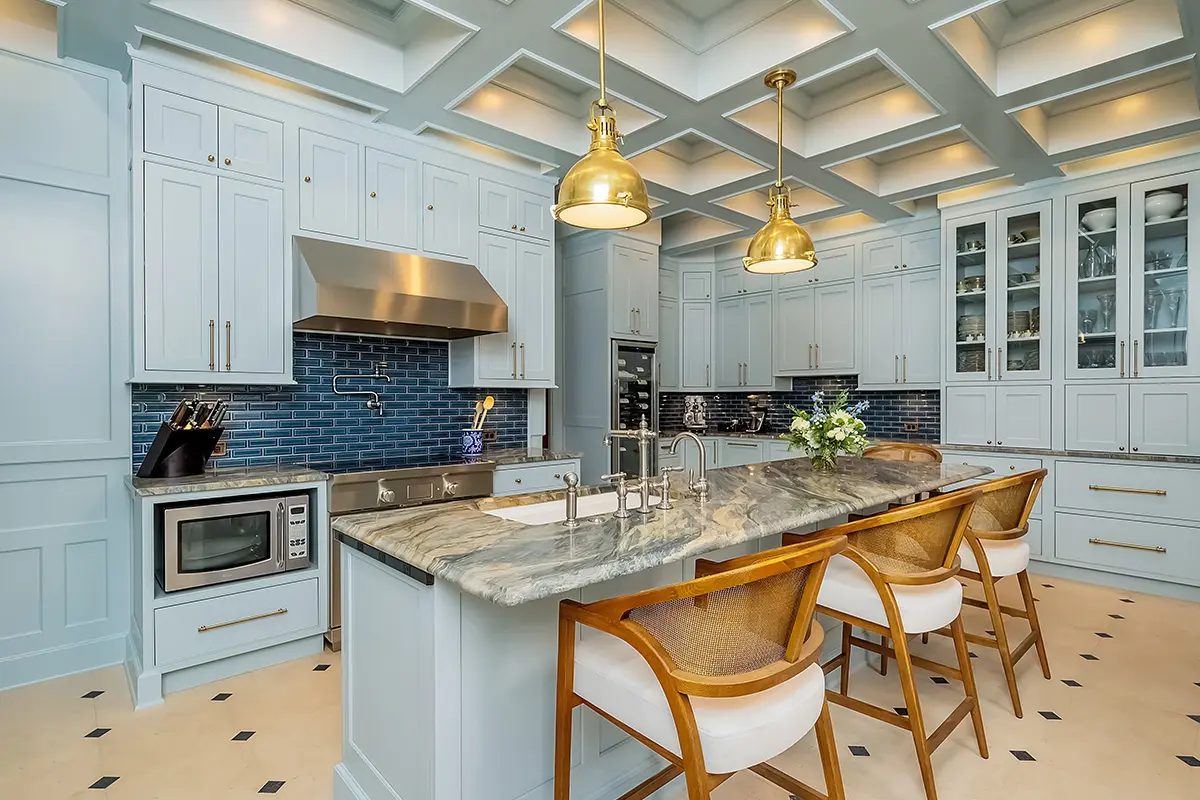
The front is where the cabinetry is judged.
Front style drives proportion, finish behavior, hardware clearance, cleanability, and cost. Each category below lists its character, where it commonly lands, the material directions that suit it, and the details worth resolving before fabrication.
Slab fronts
A single flat plane. The material, the grain direction, and the reveal do all the work.
Character
Quiet and material-forward. Nothing distracts from the surface, which means the surface has to be right.
Common applications
Contemporary kitchens, media walls, bars, closets, vanities, and long continuous runs where the eye should read the wood or panel rather than a frame.
Suitable material directions
Painted MDF/HDF, hardwood, wood veneer over a stable core, or a professional decorative surface.
Details to resolve
Core stability and flatness, edgebanding or solid edge treatment, grain direction and sequencing across the run, and how the reveal lines resolve at corners and appliances.
Traditional Shaker / flat panel
Five-piece framed front with a recessed flat panel. The default vocabulary of transitional cabinetry, and easy to get subtly wrong.
Character
Familiar, calm, and durable. Proportion is everything — rail width sets whether it reads generous or generic.
Common applications
Kitchens, mudrooms, laundry, baths, and built-ins in transitional and traditional interiors.
Suitable material directions
Paint-grade poplar or MDF for crisp painted edges; white oak, walnut, maple, or alder for stain-grade.
Details to resolve
Stile and rail widths held consistently across a run, panel material for paint versus stain, inside profile, and how small drawer fronts are handled where a full frame will not fit.
Slim / narrow-rail Shaker
The same five-piece logic with a reduced rail, giving a lighter, more contemporary frame line.
Character
A thin, precise frame that keeps the shadow line of a Shaker without the visual weight.
Common applications
Transitional kitchens that need to sit next to modern architecture, offices, bars, and vanities.
Suitable material directions
Paint-grade and stain-grade hardwood; less forgiving in softer species.
Details to resolve
Stability at the reduced rail width, hinge boring and pull placement in the narrower stile, and whether the same rail width can carry across the smallest fronts in the run.
Beaded profiles & beaded frame details
A fine bead worked into the door frame, the face frame, or both.
Character
A crisp shadow line that outlines the opening and adds historical depth without applied ornament.
Common applications
Period-sensitive remodels, butler's pantries, libraries, and cabinetry meant to read as furniture.
Suitable material directions
Paint-grade for the sharpest bead; stain-grade hardwood where the grain suits it.
Details to resolve
Bead size relative to the door, corner treatment, how the bead terminates at fillers and end panels, and whether the bead sits on the door, the frame, or both.
Fluted, reeded & ribbed fronts
A repeating vertical (or horizontal) profile across a front or panel. Best used selectively.
Character
Tactile and rhythmic. It reads as a deliberate feature, which is exactly why it should not cover an entire room.
Common applications
Islands, bar fronts, vanity fronts, end panels, and feature cabinetry inside an otherwise calm run.
Suitable material directions
Paint-grade for crisp uniform profiles; hardwood or veneer where the flute should show grain; certain decorative panels offer factory-formed textures.
Details to resolve
Flute pitch and depth relative to the front size, how the profile lands at edges and reveals, finish coverage inside the profile, and cleanability.
Kerf-line & routed geometric detail
Machined lines or geometric relief in an otherwise flat front, where the material and method allow.
Character
A modern, graphic detail that catches light without adding a frame.
Common applications
Feature panels, media walls, office cabinetry, and headboard-style built-ins.
Suitable material directions
Paint-grade panel stock most reliably; some hardwood and veneer applications.
Details to resolve
Feasibility for the specific material, edge and finish behavior inside the cut, layout alignment across multiple fronts, and whether the detail survives the finishing schedule.
Glass, metal mesh & specialty inserts
A framed front with something other than a wood panel in the opening.
Character
Opens the cabinetry up visually. Mesh adds texture and ventilation; glass adds depth and display.
Common applications
Display uppers, bars and beverage centers, libraries, media cabinetry needing ventilation or IR access.
Suitable material directions
Clear, reeded, seeded, or antique glass; brass, blackened, or woven metal mesh; specialty panels.
Details to resolve
Frame width to carry the insert, retention method, hinge selection for the added weight, interior finish and lighting since the inside will be visible, and who supplies and installs the glass.
Raised panel & mitered fronts
Traditional five-piece fronts with a profiled center panel, or a mitered frame with continuous grain around the corner.
Character
Depth and shadow. A raised panel reads traditional; a mitered frame reads as furniture, with the profile running unbroken through the corners.
Common applications
Traditional and transitional kitchens, butler's pantries, libraries, primary baths, and cabinetry meant to match existing period millwork.
Suitable material directions
Stain-grade hardwood — white oak, red oak, cherry, alder, maple, hickory — or paint-grade for a crisp profiled edge.
Details to resolve
Panel profile and frame profile selection, corner behavior at the miter, wood movement at the floating panel, and finish coverage in the profile.
V-groove, grooved & plank fronts
A panel broken into planks by machined V-grooves or reveals, rather than left as a single face.
Character
Quiet rhythm and a farmhouse or coastal reference, without the weight of applied battens.
Common applications
Island and bar fronts, mudrooms, laundry, pantries, banquette bases, and ceilings or wall panels detailed to match.
Suitable material directions
Paint-grade for the crispest groove; white oak, alder, and pine where the grain should show through.
Details to resolve
Groove spacing relative to the front width, whether grooves align across adjacent doors and drawers, groove depth and profile, and how finish and dust behave inside the cut.
Board-and-batten & applied-molding fronts
Applied vertical battens or applied molding worked over a panel to build a specific historical or custom profile.
Character
Substantial and hand-built. The relief is genuinely applied rather than routed, so shadows are deeper.
Common applications
Hill-country and ranch cabinetry, entry and mudroom built-ins, furniture-style islands, and period-matching work.
Suitable material directions
Paint-grade for a monolithic painted result; hardwood or pine where the batten should read as timber.
Details to resolve
Batten width, spacing, and thickness, how the added thickness affects hinge and pull clearance, joint treatment where the batten meets the frame, and caulk and finish behavior at the seams.
CNC-cut, mullion & decorative glass doors
Machined mullion patterns, cut-glass grille work, and geometric door faces produced on the CNC to a drawn pattern.
Character
The most bespoke front we make. The pattern is drawn for the project rather than chosen from a catalog.
Common applications
Display uppers, bars and beverage centers, china and pantry cabinetry, library doors, and feature panels in an otherwise plain run.
Suitable material directions
Hardwood or paint-grade frames with clear, reeded, seeded, fluted, antique, or leaded glass; metal mesh and perforated panels where ventilation matters.
Details to resolve
Mullion width and pattern at the actual door size, glass type and who supplies it, retention and safety of the glazing, hinge selection for the added weight, and interior finish and lighting because the inside will be seen.
Louvered & slatted fronts
Angled slats in a frame, used where a front has to breathe.
Character
Texture plus airflow. Reads coastal, traditional, or utilitarian depending on slat scale and finish.
Common applications
Laundry and utility cabinetry, appliance and equipment enclosures, HVAC and A/V access panels, closets, and dry-goods pantries.
Suitable material directions
Stain-grade hardwood or paint-grade; slat pitch is limited by the material and the door size.
Details to resolve
Slat angle and spacing against the actual ventilation requirement, cleanability, finish access between slats, and frame stability at larger door sizes.
Integrated & edge-pull slab expressions
Finger-pull, edge-pull, or continuous-channel fronts where no decorative hardware is used.
Character
The cleanest possible front. Function is built into the edge rather than added to it.
Common applications
Contemporary kitchens, media walls, closets, and any run where a pull would break the plane.
Suitable material directions
Slab fronts in paint-grade, veneer, or decorative surface — subject to the edge detail being achievable in that material.
Details to resolve
Whether the material and edge treatment support the pull geometry, ergonomics and hand clearance, wear and cleanability at the touch point, and coordination with push-open or motor-assisted hardware.
Our door program & specialty fabrication
Where the fronts actually come from, stated plainly.
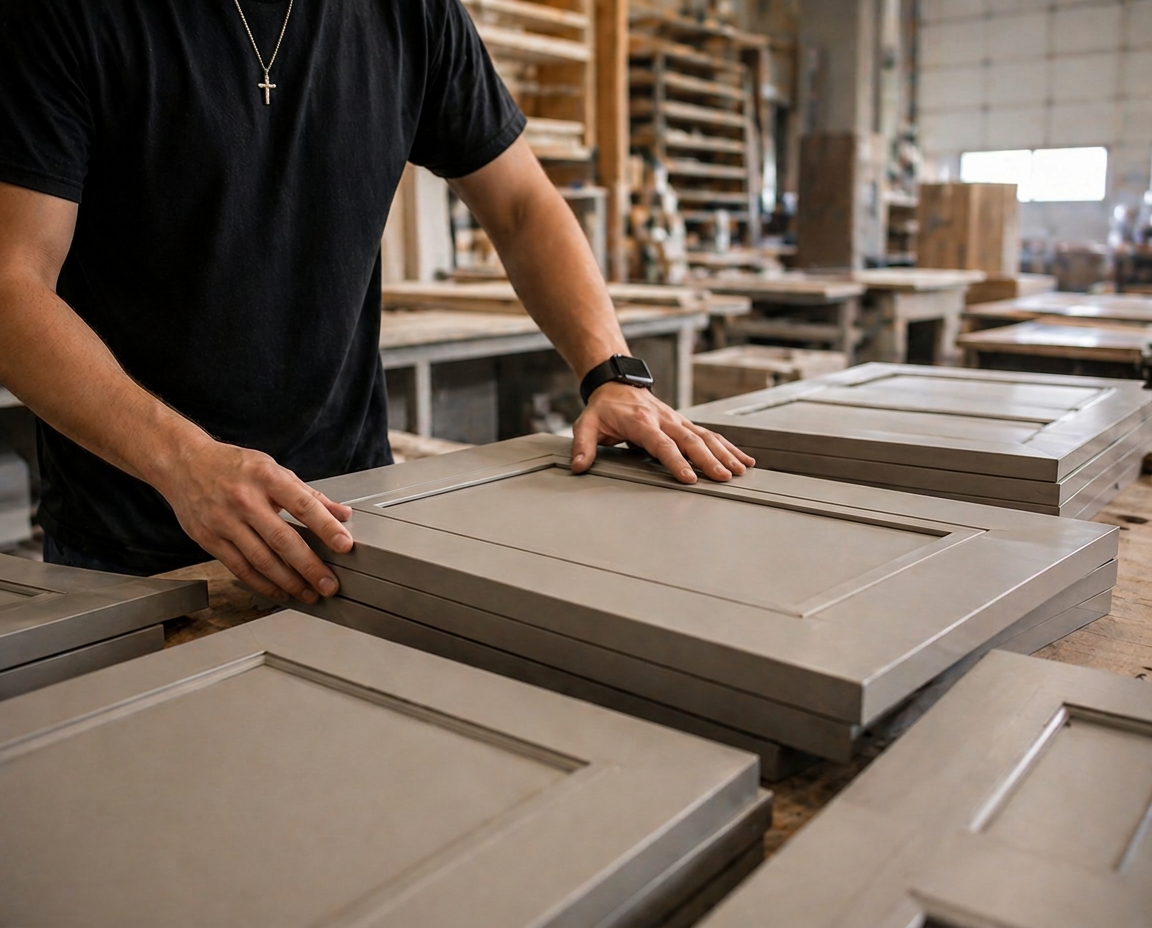
Taylor Craft Door Company — our primary door vendor
Most production door and drawer-front profiles on our projects are ordered through Taylor Craft Door Company. Working with an established door manufacturer gives the project consistent profiles, consistent joinery, and repeatable results across a large package.
Why a door vendor at all
A dedicated door shop running one operation at volume holds tighter tolerances on standard profiles than a general cabinet shop can while it is also building boxes, panels, and installs. We use that where it makes the cabinetry better.
Specialty doors we make ourselves
Beaded frames and beaded profiles, V-grooved and grooved plank fronts, board-and-batten and applied-molding fronts, CNC-cut mullion and glass doors, louvered and slatted fronts, curved and radius fronts, oversized fronts, and one-off patterns drawn for a single project.
CNC work
Pattern doors, mullion grids, kerf-line and routed relief, and machined decorative panels are cut in-house from the approved drawing file, which is how a non-catalog detail stays repeatable across a run.
How the two paths get decided
Profile, material, scale, finish schedule, hardware clearance, quantity, and lead time. Whichever path a front takes, it is drawn and approved before anything is ordered or cut, and the studio stays accountable for the whole package.
What we won't claim
We do not imply every profile is milled in our own shop, and we do not promise a profile before it has been reviewed against the specified material. If a detail will not hold up in that material, we say so and propose an alternative that keeps the design intent.
Matching an existing door
Bring a sample door, a photograph with a scale reference, or the original specification. We will tell you whether it can be matched through our door program, made as a specialty front, or only approximated — before it becomes a change order.
How to read the imagery
Imagery is shown only where the photograph clearly matches the front style being described. If a style depends on a project-specific drawing, exact rail width, routed pattern, or custom applied detail, we leave the section text-first rather than showing a misleading picture. Profile, rail width, sheen, and color are confirmed on drawings and physical samples.
Have a front detail you want tested against the material?
Send the elevation or the reference image. We'll tell you what holds up in paint-grade, in hardwood, and in a decorative panel — and what changes if it doesn't.