
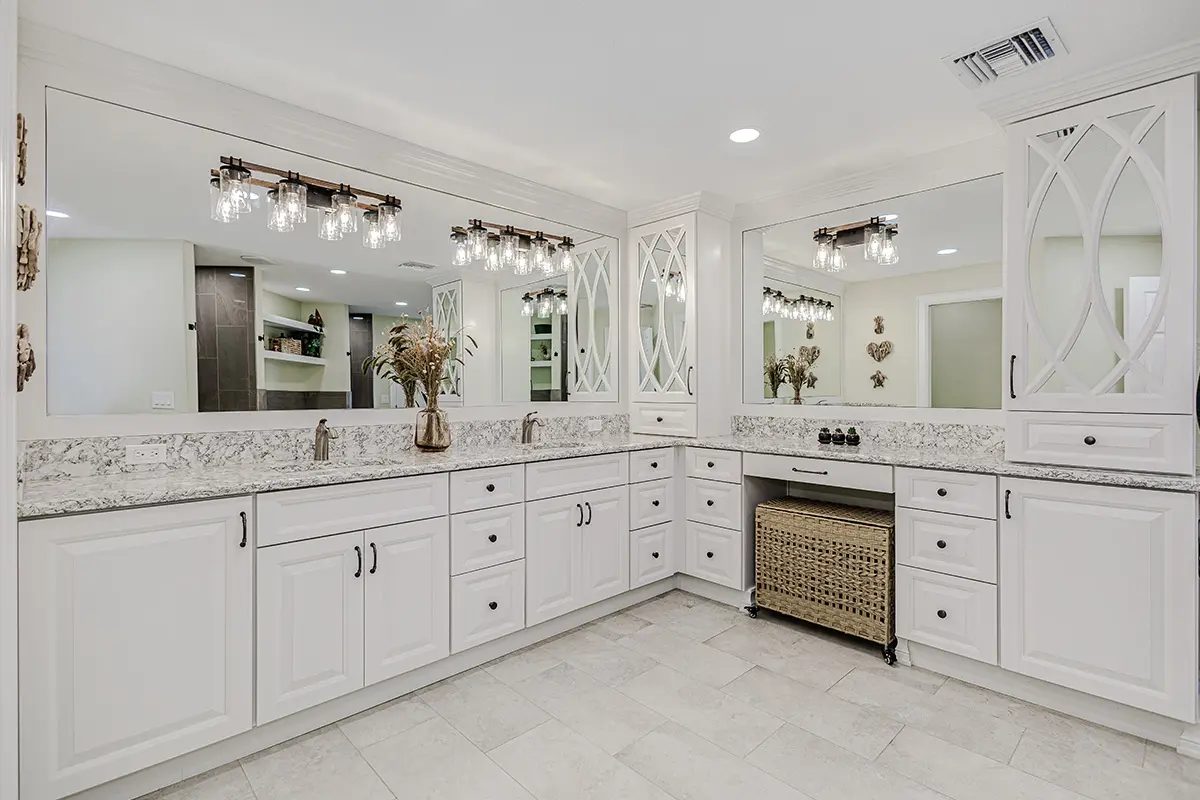
Hardware is what the client touches every day.
Hinges, runners, lift and pocket systems, drawer boxes, and interior fittings are specified during design development and drawn on the approval set — because clearance, boring, and mechanism feasibility cannot be corrected after the boxes are built.
Hinges & door control
The hinge decides how the door sits, how it opens, and how long it stays aligned.
Concealed European hinges
Fully hidden when the door is closed, with three-axis adjustment for alignment. The default for most overlay and inset work.
Integrated soft-close
Dampening built into the hinge, or clip-on where the selected hinge family supports it, so doors close quietly and consistently.
Push-to-open & touch latch
Mechanical push-open and touch-latch options for handleless fronts, specified with the front style rather than added later.
Wide-angle & zero-protrusion
Opening angle chosen against adjacent walls, appliances, and pull-out clearance, including zero-protrusion types next to a drawer bank.
Bi-fold & thick-door hinges
Bi-fold hardware for folding door pairs, and thick-door hinges where the front exceeds standard door thickness.
Inset applications
Flush inset and beaded inset are hinge-sensitive; hinge type is chosen alongside the reveal specification, not after it.
Glass & metal-frame hinges
Hinges made for glass doors and aluminum-frame fronts where display or ventilation drives the design.
Special applications
Corner, blind-corner, angled, and other special-application hinges evaluated against the actual cabinet geometry.
Drawer runners & motion
Motion quality is the most-touched part of any cabinetry package.
Undermount soft-close
Concealed full-extension runners with dampened closing, so the drawer box is what you see rather than the hardware.
Side-mount runners
Used where budget, drawer construction, retrofit conditions, or a specific application make them the right call.
Push-to-open
Mechanical push-open runners for handleless and integrated-pull fronts.
Push-to-open soft-close
Combined push-open and dampened closing where the selected runner family offers a compatible version.
Heavy-duty & specialty runners
Specified where the application justifies it — deep pantry drawers, equipment drawers, and unusual widths or depths.
Premium metal drawer systems
Optional manufactured metal drawer systems where the interior expression and motion feel are part of the design intent.
Electrically assisted opening
Systems such as Blum SERVO-DRIVE can be specified where the design calls for touch-to-open on handleless fronts, when coordinated with the electrical trade.
Capacity
Runner capacity is matched to drawer size and expected contents. We do not publish load figures here; ratings come from the exact selected manufacturer and product.
Lift, pocket, sliding & coplanar systems
Hardware that lets a door move out of the way instead of standing open in the room.
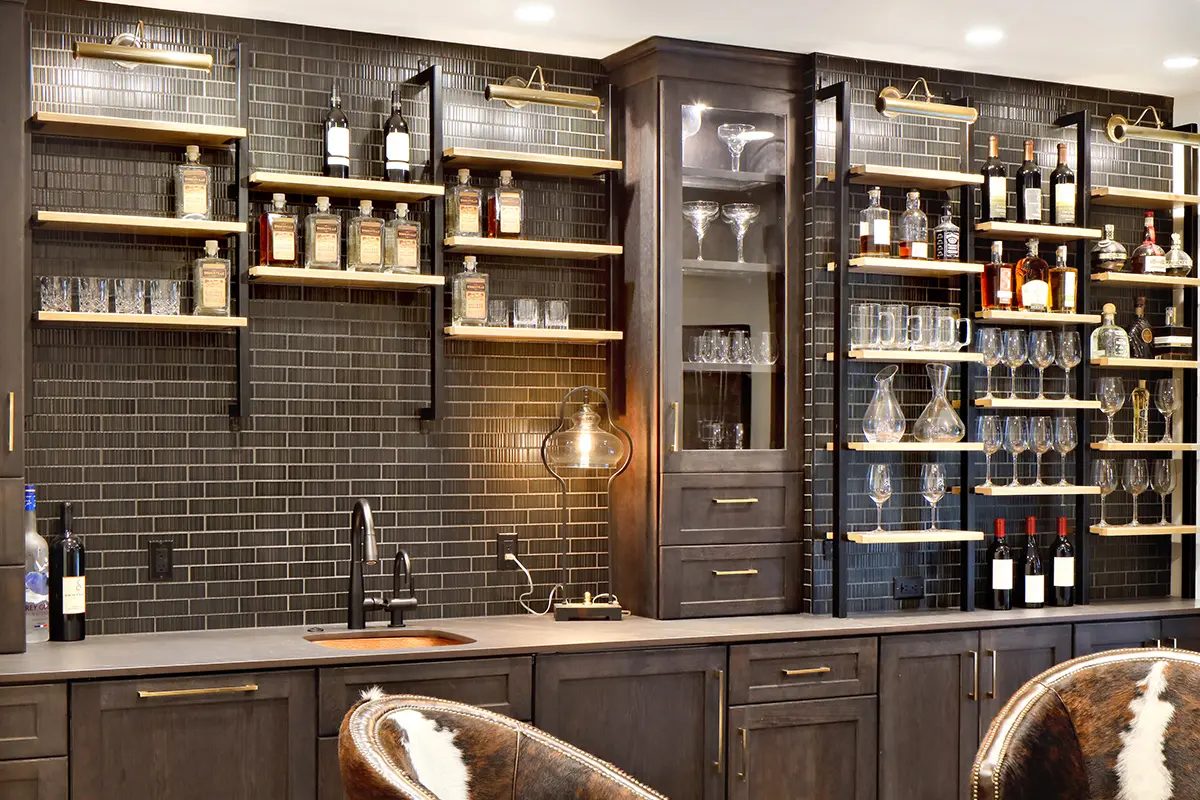
Lift systems
Upward-opening hardware for uppers and tall openings — Blum AVENTOS lift systems are a common example — selected by door size, weight, and opening height.
Retractable pocket doors
Doors that open and slide back into the cabinet body. Blum REVEGO pocket systems, Hettich retractable and pocket-door fittings, and Salice Exedra-type pocket systems are examples, along with comparable systems where appropriate.
Sliding & coplanar
Sliding and coplanar door hardware where fronts move across the face of a run rather than swinging into the room.
Bi-fold & flipper doors
Folding pairs and flipper fronts for openings where a single swing would block circulation or an adjacent appliance.
Where these get used
Appliance garages, coffee bars, pantries, media cabinetry, laundry concealment, home offices, and bars — anywhere a front needs to disappear during use.
Feasibility dependencies
Feasibility depends on door size and weight, front material, cabinet geometry, surrounding clearances, any electrical requirement, and the manufacturer's current technical data — confirmed before the system is promised.
Interior organization
The inside of the cabinetry is where daily use is decided.
Waste & recycling
Concealed pull-out waste and recycling units coordinated with bin sizes, door swing, and adjacent plumbing.
Roll-outs & pull-out shelves
Roll-out trays and pull-out shelves sized to the opening and to what actually gets stored.
Pantry pull-outs
Full-height and base pantry pull-outs specified against the opening width and the loading pattern.
Blind-corner solutions
Corner access hardware evaluated against the real plan geometry rather than an assumed corner.
Tray & baking-sheet dividers
Vertical dividers for trays, boards, and sheet pans in base or tall cabinetry.
Spice & utensil storage
Dedicated spice pull-outs, utensil inserts, and knife storage detailed against the client's workflow.
Drawer inserts & dividers
Wood or manufactured inserts and fixed or adjustable dividers fitted to the actual drawer opening.
Sink base organization
Sink-base storage, tilt-out fronts, and drip protection planned around plumbing and disposal locations.
Appliance lifts
Lift mechanisms for mixers and small appliances where the cabinet size, weight, and power access support it.
Closet & wardrobe options
Hampers, valet rods, pull-down hanging, shoe storage, and jewelry or accessory trays when they are in scope.
Decorative pulls & knobs
Typically owner- or designer-supplied, always coordinated.
Who supplies it
Decorative hardware is frequently specified and supplied by the designer or homeowner.
What we need
Model, size, and mounting centers before fabrication, so boring is correct the first time.
Placement
Pull placement is drawn on the approval set, not decided at installation.
Finish coordination
Metal finish is coordinated with hinges, lighting, plumbing, and any exposed structural elements.
Handleless alternatives
Edge-pull and integrated-pull fronts remove decorative hardware from the equation entirely.
Manufacturers & sources
Named as examples of where hardware, motion, lighting, and organization solutions come from — not as partnerships.
Blum
An example manufacturer for hinges, runners, lift systems, pocket systems, and electrically assisted opening.
Hettich
An example manufacturer for hinges, runners, sliding and retractable/pocket-door fittings, and drawer systems.
Salice
An example manufacturer for hinges, runners, lift systems, and pocket-door systems.
Häfele
An example manufacturer and source across hardware, motion, lighting, and organization categories.
Rev-A-Shelf
An example manufacturer for interior organization, waste units, pull-outs, and closet accessories.
Richelieu
An example manufacturer and source across hardware, functional fittings, and decorative categories.
Würth Louis & Company
A professional distributor and source for hardware, components, and supplies — a distribution channel, not a hardware system brand.
How selection actually happens
Category by category and application by application, against current manufacturer technical data for the exact product under consideration.
Brand References
Manufacturer names are examples of professional sources used for specification. They do not imply endorsement or guaranteed stock. See Design Library.
How hardware gets specified
Selection follows the project and the application, not a house brand.
Quality tier is a decision
We specify hardware appropriate to the project's use, budget, and expected service life, and say plainly what each tier buys.
Products confirmed per project
Product lines and availability change, so the specified manufacturer and product are confirmed during design development.
Drawn before it's ordered
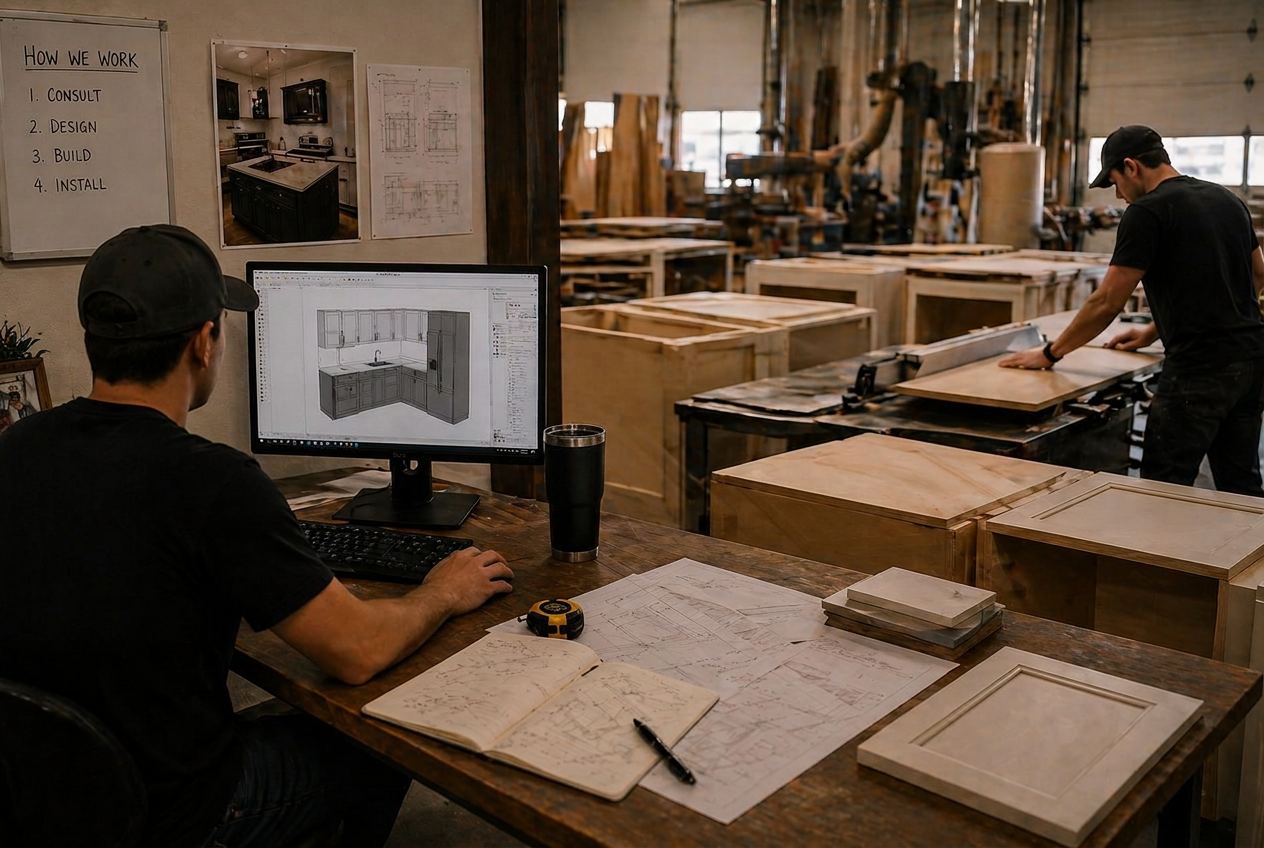
Hinge type, runner type, clearances, mechanism intent, and pull placement appear on the Cabinet Vision approval drawings for written sign-off.
No published ratings
Load capacities, cycle counts, and compatibility claims come from the selected manufacturer's current data, not from this page.
Client-supplied hardware
We will install owner- or designer-supplied hardware when specifications are provided in time for fabrication.
Serviceability
We favor hardware that can be adjusted and replaced years later over hardware that cannot.
Warranty and manufacturer terms
Hardware carries the manufacturer's own warranty terms, which vary by product line. We confirm the applicable terms for the hardware actually specified on a project rather than stating a blanket guarantee here.
Electrically assisted and powered systems are coordinated with the project's licensed electrical or low-voltage trade during design. We do not imply the studio installs or commissions powered systems unless a written scope says so.
Working out storage before the drawings are final?
Send the plan and how the space is actually used. We'll propose the access hardware and interior fittings that fit the geometry and the budget.